
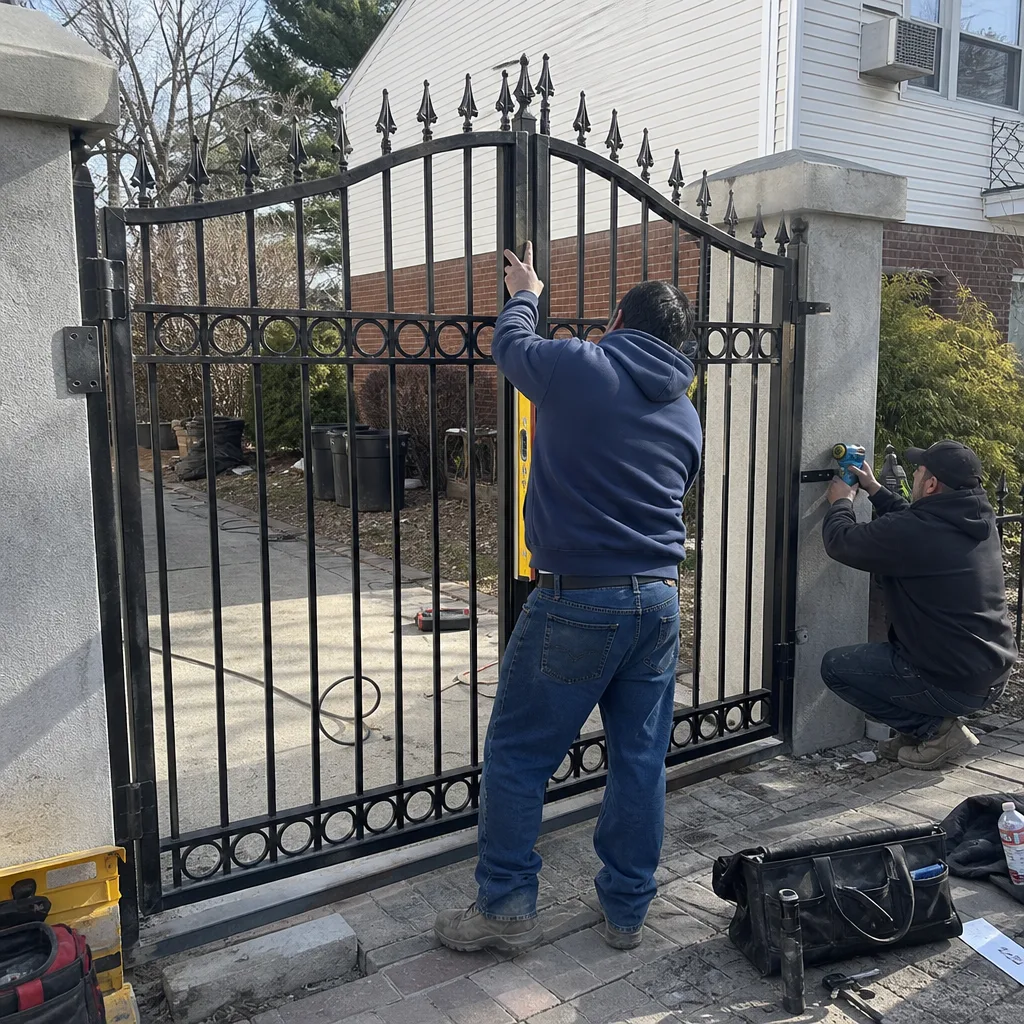
Last updated October 16, 2026
 Wrought iron
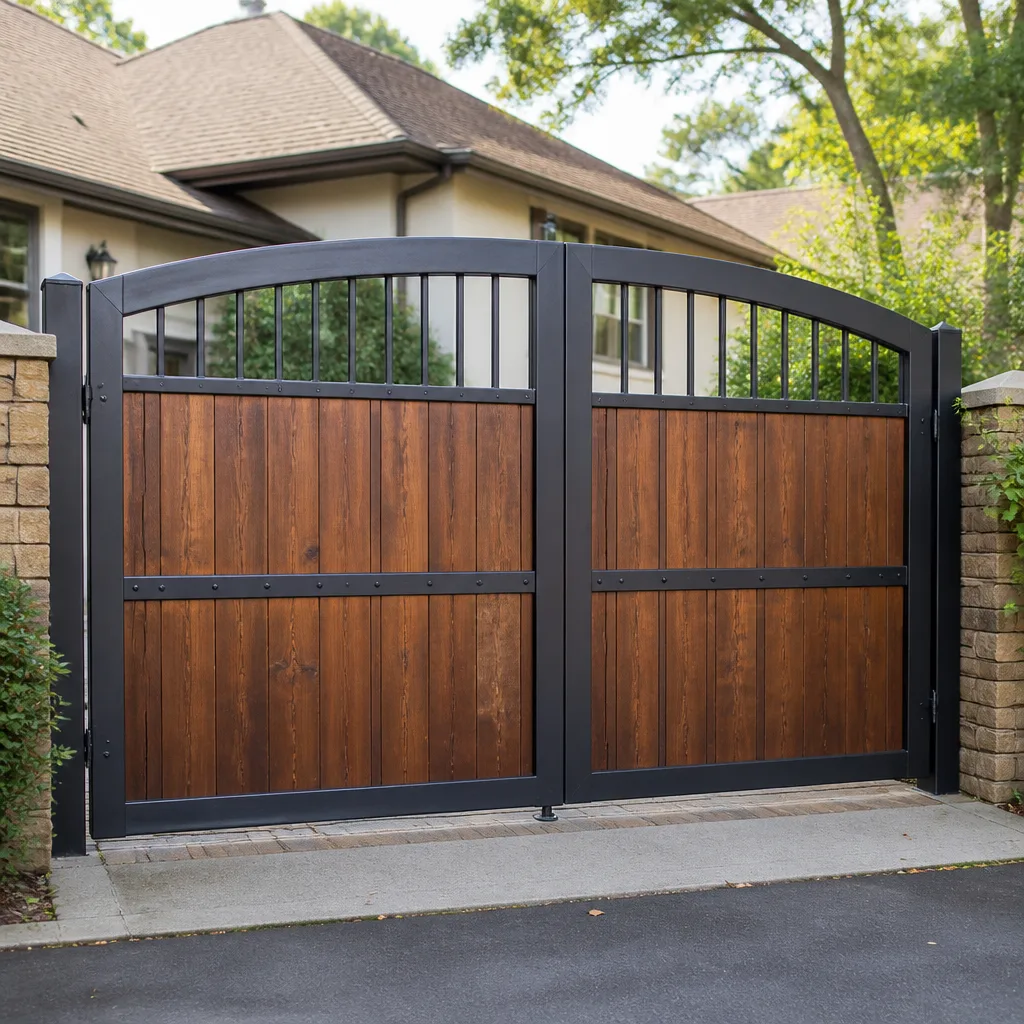 Wood & steel frame
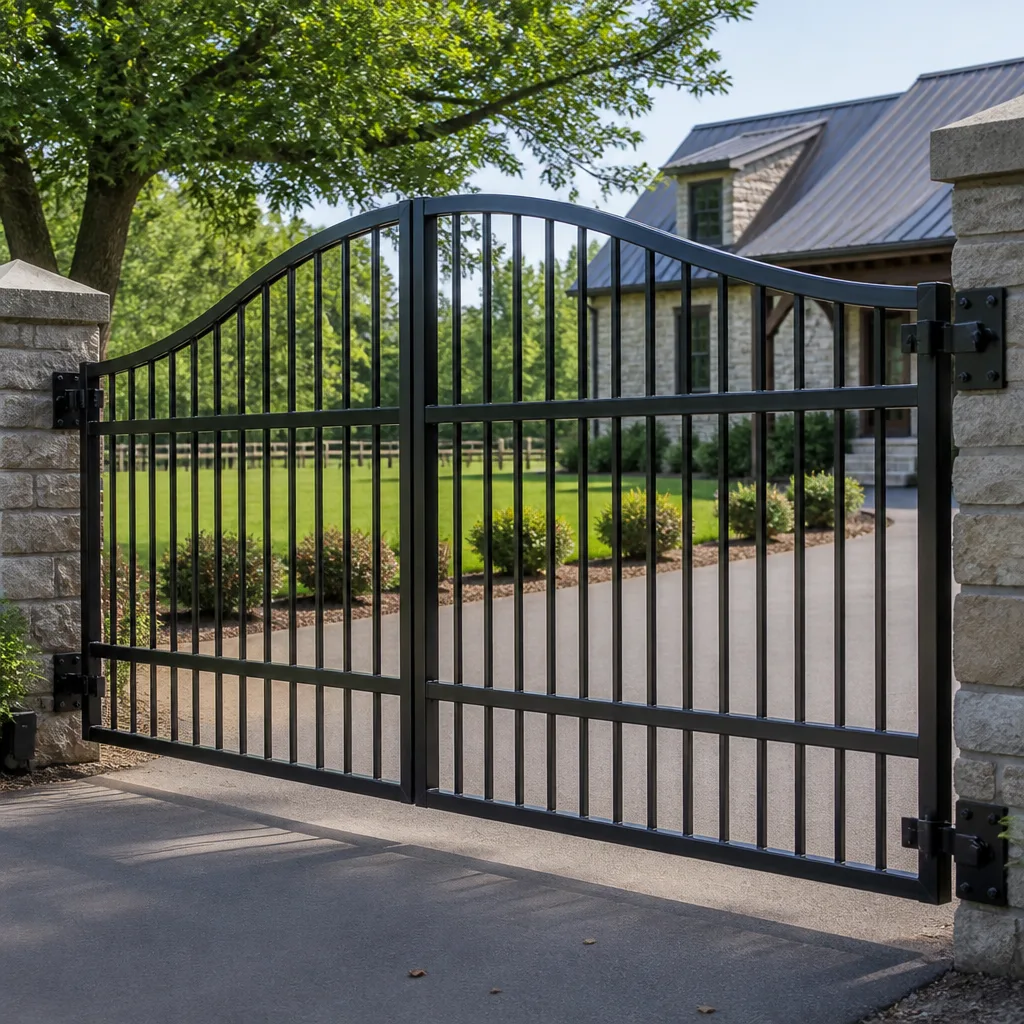 Farm & ranch
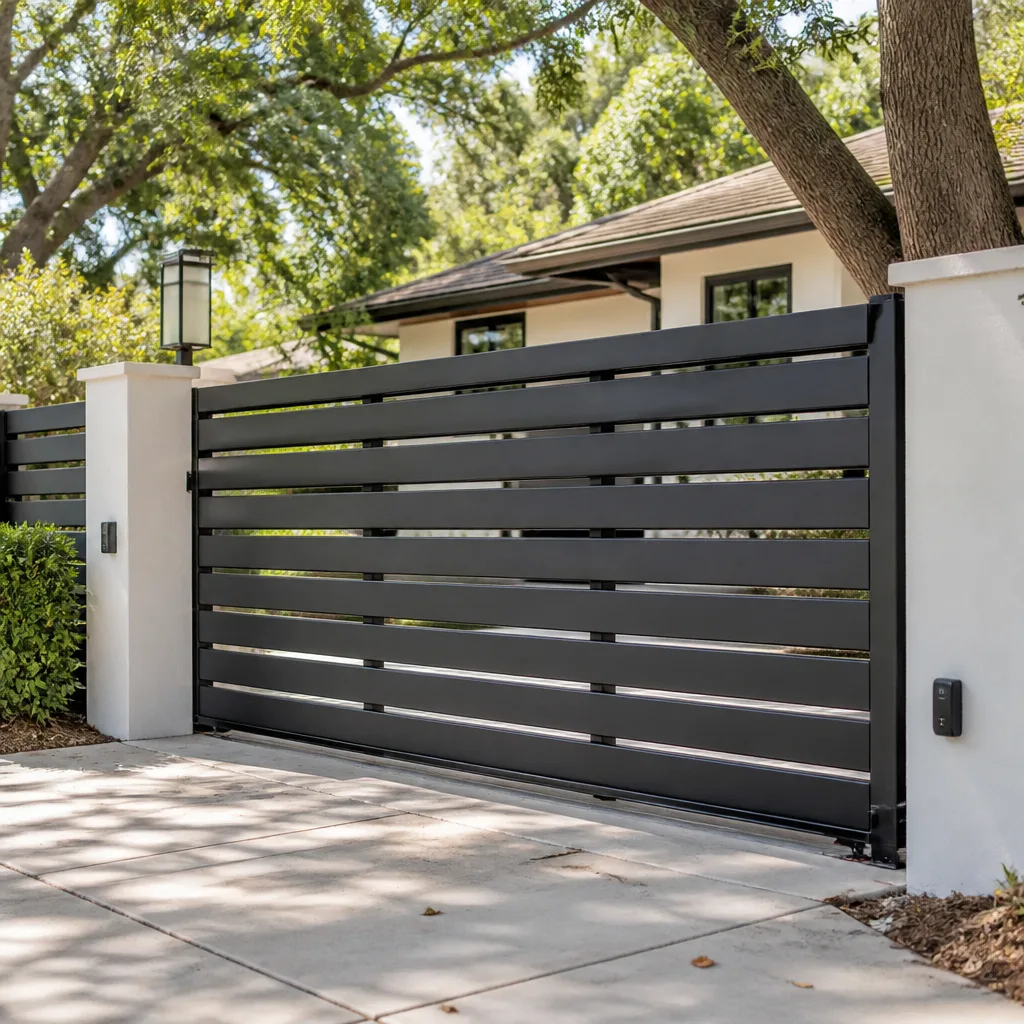 Sliding driveway gates
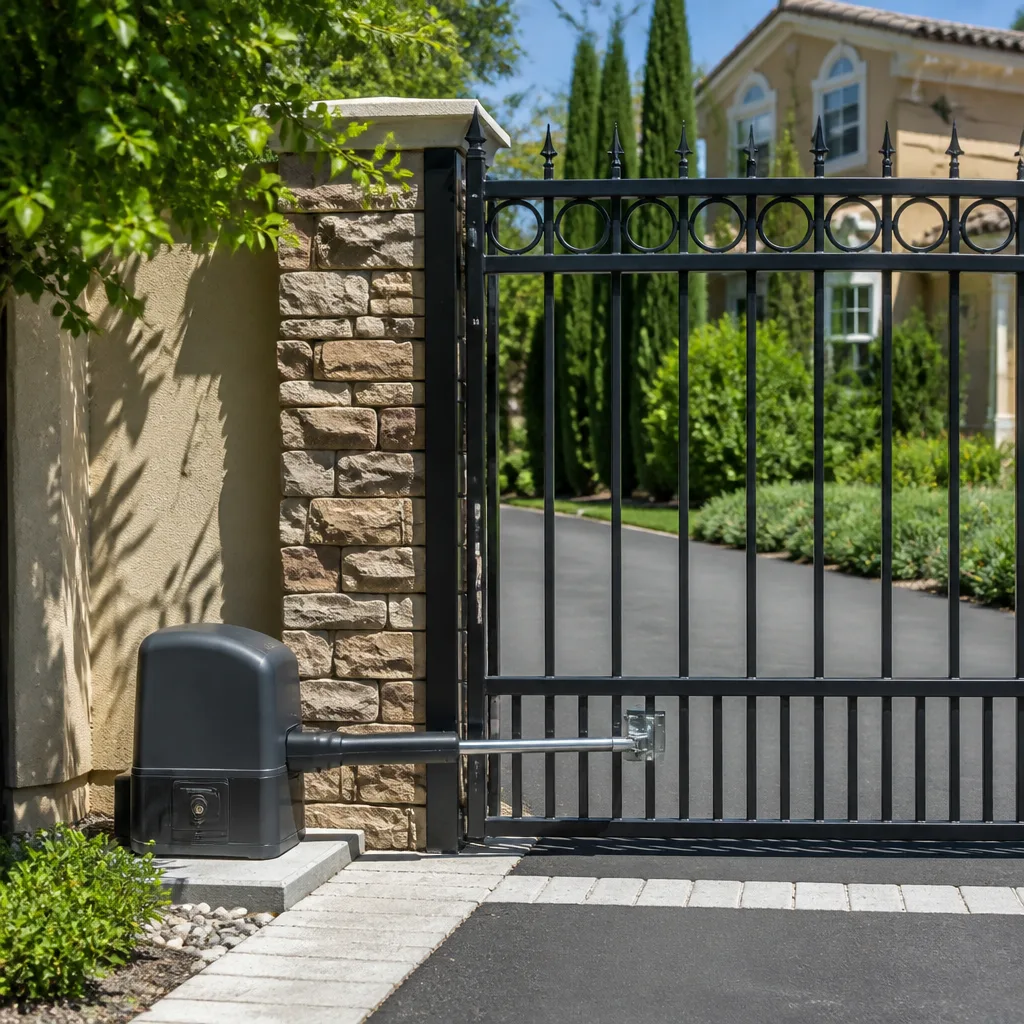 LiftMaster operators
Free on-site gate assessment - hinges, posts, and your LiftMaster or Nice gate operator checked before anything is quoted
The assessment is free and the quote is the invoice.
Get your free estimateGate Repair Maintenance Checklist for New York Homeowners
The single most skipped maintenance step on New York driveway gates is cleaning the bottom track in October, and in our experience it’s the direct cause of roughly half of all “gate won’t open” calls we get in February. Leaves, grit, and road salt settle into the track, the first freeze glues it all in place, and the operator burns itself out trying to shove a gate that can’t move. This guide covers the full seasonal maintenance cycle for New York gates: what to check each month, which products actually work on hardware in this climate, what a homeowner can safely do versus what needs a trained technician, and how to keep a written service log so you never have to guess when something was last serviced. For related reading, see our guide to Gate Repair Warning Signs: A New York Homeowner’s Reference Guide.
Styles & brands we work with
Quick Answer
A New York gate needs a monthly visual check of the track, hinges, and operator, plus two deep-cleaning sessions per year tied to the weather calendar: one in October before freeze-thaw cycles start, and one in April after road-salt season ends. The core tasks are cleaning the bottom track, checking hinges and rollers for wear, testing the safety reversal, lubricating the operator chain or screw with a dry PTFE-based lube (never WD-40), and keeping a written log of every service. Most homeowner-level maintenance takes under 15 minutes a month, and the two seasonal deep cleans take about an hour each.
Table of Contents
- Why New York Gates Fail Differently Than Gates Anywhere Else
- The 15-Minute Monthly Walkthrough: What to Look and Listen For
- The October Deep Clean: Preparing for Freeze-Thaw Season
- The April Deep Clean: Undoing Winter’s Damage
- What to Use (and What to Avoid): Lubricants and Cleaners That Work on New York Hardware
- What You Can Safely Do Yourself vs. What Requires a Technician
- The Written Service Log: Why It Matters and How to Keep One
- Common Mistakes to Avoid
- When to Call a Professional
- Frequently Asked Questions
- The Bottom Line
Why New York Gates Fail Differently Than Gates Anywhere Else
Driveway gates in New York don’t wear out the same way gates in Phoenix or San Diego wear out. We’ve repaired thousands of them since 2008, and the failure pattern here is consistent and predictable. It comes down to four specific conditions that New Yorkers live with every season.
Salt air and road salt. If you live within a few miles of the coast, airborne salt corrodes exposed steel and aluminum faster than the manufacturer’s average lifespan numbers suggest. For gates on streets that get plowed and salted in winter, the same corrosion happens from below. Salt spray kicks up off the pavement and settles on the gate’s lower rail, hinges, and track. On a Gate Repair in New York call in March, we often find the bottom hinge on a steel gate is pitted and rust-frozen after just four or five winters. The fix was a hinge replacement that could have been postponed with a monthly rinse and proper lubrication from October through April.
Freeze-thaw cycling. Water gets into hairline gaps around hinges, concrete anchor bolts, and track seams. When it freezes, it expands. When it thaws, it contracts. Repeat that 30 times a winter and small cracks become spalled concrete and seized hardware. This is why October cleaning matters so much: anything in the track that holds moisture becomes an ice block in January.
Urban grime. Road film, brake dust, and exhaust particulate settle on gates that face busier streets. It’s sticky, slightly acidic, and it accelerates corrosion in ways that a rinse-down every couple of weeks will prevent. For properties on through streets or near commercial corridors, we recommend including the gate in whatever you do for the car: a quick rinse after a dirty week.
Vibration from heavy traffic. If a gate sits within 50 feet of a bus route, a truck route, or an elevated train line, the constant low-frequency vibration works bolts loose and fatigues hinge welds over time. Most homeowners never notice until a hinge bolt backs out completely and the gate drops. One weekly task solves this: walk the gate and look for rust dust or paint flaking around bolt heads, which signals movement you should address before the bolt walks out.
Understanding these four enemies changes how you maintain the gate. It’s not about doing more work, it’s about doing the right work at the right time. And it starts with a monthly walkthrough that takes less time than brewing coffee.
We’re Portcullis Gate Repair New York, an independently owned Kingswell location. Every repair we do in New York carries a written price before work starts and a 365-day written guarantee. The maintenance schedule below is what we’d tell our own neighbors, and have, many times over.
The 15-Minute Monthly Walkthrough: What to Look and Listen For
This is the core of the whole checklist. Once a month, walk out to your gate with a flashlight and your phone, and spend fifteen minutes doing these five things in order. You don’t need tools, and you don’t need experience. You need eyes and ears.
Step 1: Watch One Full Open-and-Close Cycle
Stand where you can see the gate from end to end, and run one full cycle with the remote or keypad. Watch for three things: hesitation, scraping, and speed changes. A gate that hesitates halfway through its travel before continuing usually has resistance in the track or a failing capacitor in the operator. A gate that scrapes against the ground or the column has a hinge or roller problem that will get worse. A gate that opens faster than it closes, or vice versa, may have an unbalanced spring or a limit switch that’s drifted.
Step 2: Listen for New Noises
A healthy gate makes a consistent mechanical sound. A grinding noise means metal-on-metal contact without lubrication. A rhythmic clicking or popping often means a worn chain link or a damaged gear tooth. A high-pitched squeal that happens only in cold weather is usually an under-lubricated or worn bearing. If the noise is new, note it in your log and investigate the same week. Most Electric Gate Repair in New York calls are for problems that announced themselves with a noise users ignored for two months.
Step 3: Inspect the Track Clearance
For a sliding gate, the bottom track (or the ground rail for a cantilever gate) should be visible along its entire length. Leaves, gravel, ice melt crystals, and litter all collect there. In autumn, check the track every week, not monthly, because leaf accumulation blocks the gate within days on tree-lined streets. For a swing gate, check the ground clearance along the arc; if one corner of the gate is closer to the ground than the other, a hinge is wearing.
Step 4: Check Hinges and Rollers by Hand
Put your hand on each hinge while the gate is moving (or just after it stops) and feel for vibration, clicking, or movement you can’t see. For rollers, try to wiggle each one with your fingers; play of more than about ⅛ inch means the bearing is wearing. Each roller carries a share of the gate’s weight, and a worn roller puts extra load on its neighbors, which accelerates a cascade of failures.
Step 5: Run the Safety Reversal Test
Place a 2×4 or a similar object in the gate’s path and close the gate into it. The gate should reverse immediately on contact. Do this once a month without exception. The safety reversal is the one component whose failure turns a maintenance issue into a safety emergency. If it fails, stop using the gate and call a technician. This is not a lubrication or cleaning fix; this is an operator logic or sensor fault.
Record the date and anything you saw or heard in your service log, which we cover below. That’s it. Fifteen minutes, five checks, one log entry.
The October Deep Clean: Preparing for Freeze-Thaw Season
The October deep clean is the single most important maintenance session on the New York calendar. It happens before the first hard freeze, and it’s designed to address the four enemies in one pass: remove debris that will freeze, remove salt and grime that will corrode, add the right lubrication before cold weather thickens what’s in there, and tighten anything vibration has loosened.
Plan for about an hour, and do it on a dry day when the temperature is above 50°F so that everything you apply can flow and cure. Here is the sequence we recommend, and the sequence our technicians use when a customer hasn’t maintained the gate in a while.
- Clear and clean the full track. Use a stiff-bristle brush and a shop vacuum, not a pressure washer focused on the track seals. Remove every leaf, every pebble, every crust of salt. For a cantilever gate with no ground track, clean the rail and the roller channels above the gate as well as the ground path.
- Wash the gate and the column. A bucket of warm water with a capful of mild car-wash soap and a soft brush is enough. Focus on the lower 12 inches of the gate, where road salt concentrates. Rinse thoroughly and dry with a towel, especially around hinges and electrical enclosures.
- Inspect every bolt and anchor you can see. Look for rust streaks running down from bolt heads, which mean moisture is entering and the bolt is loosening. Use a wrench to confirm torque on the ones you can reach. If a bolt moves easily, it needs attention before winter vibration finishes the job.
- Lubricate hinges, rollers, and the operator drive. Use a dry PTFE-based spray on hinges and rollers, and the manufacturer-recommended lube on the operator chain or screw. More on product specifics below.
- Test the safety reversal and the manual release. The manual release is the cord or lever that disconnects the operator so the gate can be pushed by hand in a power outage. Exercise it once, confirm the gate moves freely, and re-engage it.
- Photograph and log everything. Stand back and take three photos: the gate closed, the operator, and the hinges. If something changes over the winter, those photos give a technician an exploded “before” that shortens diagnosis.
Skipping this session is the most common way New York homeowners turn a $140 service call into a $700-plus repair. In January, a frozen track full of leaves means the operator strains against the gate until a gear strips or a capacitor pops.
The April Deep Clean: Undoing Winter’s Damage
April is about inspection and correction. Winter has done whatever it’s going to do, and you can now see the cumulative effect of three or four months of salt, freeze-thaw, and vibration. This session is a forensic pass: find what winter damaged while the damage is still small.
- Repeat the full October sequence. You’re doing the same clean, wash, and lubrication, but now you’re doing it with the specific goal of flushing road salt off the bottom of the gate and the track before spring humidity gets a full season to accelerate corrosion.
- Look closely at the concrete anchors and hinge pads. Freeze-thaw cycles will have opened hairline cracks around anchor bolts. Hairline is fine; if a crack is wide enough to fit a coin edge or a bolt head moves when you wrench it, that’s a repair call.
- Check for paint bubbling or flaking along the bottom rail. Bubbled paint means corrosion is working underneath. Scuff it back with sandpaper, apply a rust converter, and touch it up with a cold-galvanizing primer and matching paint. On a steel gate, an afternoon of touch-up in April adds years of life.
- Run the motor and count. Open and close the gate five times in a row while timing each cycle. All five should be within a second of each other. A cycle time that’s creeping up means the motor is working harder and bearings or the drive are wearing.
- Review your winter log entries. If you noted new noises or any failed safety tests during the winter, act on them now. The problems that appear in winter are best fixed in spring, when ice isn’t hiding the root cause.
April is also the right moment for a Gate Installation in New York if the winter has convinced you the existing gate has entered its final years. Our installation team quotes a written price before any work, and every new install includes the same written guarantee as a repair.
What to Use (and What to Avoid): Lubricants and Cleaners That Work on New York Hardware
Product choice is the place we see well-meaning homeowners do the most accidental damage. The wrong lubricant attracts exactly the grit you’re trying to keep out. The right one repels it.
Use this on hinges and rollers: a dry PTFE-based lubricant. “Dry” means the carrier solvent evaporates and leaves a waxy, non-tacky film. Dust and road grit do not stick to it. Brand names include Blaster, WD-40 Specialist (the dry lube, not the original), and 3-IN-ONE dry lubricant. One light pass per hinge per month during the deep-clean sessions is enough.
Do not use these two products on hinges, rollers, or tracks, and here’s why. First, original-formula WD-40. It’s a water displacer, not a lubricant, and it leaves an oily film that grabs gritty dust and turns into grinding paste within a week of New York traffic. Second, white lithium grease from an aerosol. It’s too heavy, it clings to everything, and in winter it stiffens until it actually increases the load on the operator. Both of these attract grit and make things worse fast.
For the operator chain or screw: follow what’s printed on the operator housing. Ghost Controls and Viking specify a light-duty machine oil for chains. DoorKing and Elite screw-drive models usually call for a specific white grease applied in a thin ribbon along the screw. Too much lubricant on the chain flings onto the housing and attracts dust; a few drops along the full length is better than a soak.
For wash water: mild car-wash soap. Nothing stronger. Dish soap strips lubricant and degreasers remove the protective film from contact surfaces. On aluminum gates, avoid anything with chlorinated solvents.
For salt removal: plain water and agitation are all you need. Salt dissolves; scrub with your brush and rinse. If you park near the coast and deal with airborne salt film, a rinse every two weeks from October through April does more than any single product.
What You Can Safely Do Yourself vs. What Requires a Technician
Confusing these two categories is the most expensive maintenance error a New York homeowner makes, not because the DIY work is always dangerous, but because using the wrong fix on a real problem lets a $200 repair become an $800 repair. Here is the line.
Safe to do yourself: track cleaning, gate washing, visual inspection, hinge and roller lubrication, safety reversal testing, paint touch-up, bolt torque checks on non-structural fasteners, manual release testing, and log-keeping. These are all inspection and upkeep tasks that don’t change the way the gate operates and don’t require opening an electrical enclosure.
Technician territory: any repair involving the operator’s internal wiring, capacitor, logic board, or limit switches; spring tension adjustment on any gate that uses torsion or extension springs; hinge replacement on a heavy steel gate where the gate must be supported; roller replacement inside sealed bearing housings; and any safety system fault that isn’t a dirty photo-eye lens. High-tension springs and capacitor-fed motors both hold stored energy that can release suddenly, and a gate that drops off a broken hinge weighs several hundred pounds. A trained technician has the right supports and the right meter; you probably don’t, and that’s not a judgment, it’s just how the injury math works out.
As a practical rule: if the fix involves disconnecting a wire, relieving a spring, or lifting the gate off its supports, call a technician. Everything else on this checklist is yours.
The Written Service Log: Why It Matters and How to Keep One
Every technician who arrives at a New York gate asks some version of the same question: “When was the last time this was serviced?” Most homeowners answer “a while ago” or “the previous owners did something.” A written log turns a vague answer into a diagnostic asset.
Keep it simple. A spiral notebook in the garage or a note on your phone works. The log format we recommend is five columns:
- Date: month, day, year.
- Task done: “track cleaned,” “safety reversal tested,” “hinge lubricated,” and so on.
- Observation: “gate hesitates at midpoint,” “rust bubble on bottom hinge,” “cycle time 22 seconds” – anything you saw or heard.
- Product used: “PTFE dry lube,” “machine oil, 6 drops on chain.”
- Next action: “check hinge in 2 weeks,” “call for spring adjustment.”
When a technician sees a log with monthly entries, diagnosis often gets much faster because the failure history is visible. “It started clicking in December” tells us more than a two-minute conversation about a vague noise. For homeowners on our Portcullis Gate Repair New York home service area, the log is also the first thing we review when a gate fails inside the 365-day guarantee period, and it anchors the written guarantee on the invoice to the specific repair we performed.
Common Mistakes to Avoid
- Skipping the October deep clean because the gate still works. The October session is preventive. By the time the gate visibly struggles, the operator has already been straining for weeks, and the repair bill reflects it.
- Using WD-40 on hinges and rollers. It displaces water but leaves a film that captures road grit. After two weeks of New York winter traffic, it’s actively grinding the very surface it was meant to protect.
- Ignoring a new noise for a month. Every sound your gate makes is data. “It started clicking in December” is the first line of half our winter repair calls in New York, and the clicking is always cheaper to fix in December than February.
- Tightening every bolt aggressively without checking what it holds. Over-torquing a hinge bolt on an aluminum gate can strip the threads or crack the casting. Snug is enough; you’re looking for movement, not maximum torque.
- Never testing the safety reversal because it’s “annoying.” This is the one test that protects pedestrians, kids, and pets. If the gate fails the reversal test, the gate is a hazard and should be locked out of service until it’s fixed.
- Lubricating the photo-eye lenses. Photo-eyes need to be clean, not oily. Any lubricant on the lens diffuses the beam and causes nuisance reversals. Clean the lens with a damp cloth only.
- Assuming a power-failure release is a maintenance issue. The manual release should be exercised twice a year. If it sticks or won’t re-engage, the spring on the release mechanism is fatigued, and that’s a technician call, not a silicone-spray fix.
When to Call a Professional
Some conditions on a New York gate are not maintenance items. They are stop-use conditions until a technician has looked at the gate. Call a professional if the gate fails the monthly safety reversal test, if you see a visible crack in a weld or a hinge plate, if a roller has obvious play and the gate leans when it moves, if the operator hums but the gate doesn’t move (which means a stripped gear or a seized drive), or if the gate trips a breaker more than once. These are not “keep an eye on it” situations. If your log shows the same problem on three consecutive monthly entries, that’s also a call, and a useful one: you’ll be telling the technician exactly what changed and when.
Portcullis Gate Repair New York offers free estimates for New York homeowners, with a written price before any work starts and the 365-Day Done Right Promise on every repair. Call (845) 259-0242 and a live person will answer, any hour, any day.
Frequently Asked Questions
A monthly 15-minute visual check plus two one-hour deep cleans per year, in October and April, is the right cadence for New York’s climate, and it matches what we recommend to every customer at Gate Repair in New York. The October session prevents freeze-thaw damage, and the April session cleans up the corrosion winter left behind. Monthly checks catch loose hardware and new noises while they’re cheap to fix.
Debris and water frozen in the bottom track is the most common winter failure we see in New York, and it’s almost always preventable with the October deep clean. The operator strains against the frozen gate until a capacitor fails or a gear strips. The second most common is a photo-eye crusted with salt spray, which causes the gate to refuse to close or to reverse for no apparent reason.
Yes, with two rules. Use a dry PTFE-based spray on hinges and rollers, and use only what’s specified on the operator housing for the chain or screw. Never use original-formula WD-40 or white lithium grease on New York gate hardware; both attract grit and make the problem worse.
Every repair we complete carries a written 365-day guarantee printed on the invoice. If the repair fails inside that window, we return and correct it at no charge. It’s a written promise from an independently owned Kingswell location, not a verbal assurance, and it applies the same way on every job.
If the gate is moving and you’re keeping up with the monthly checklist, you’re maintaining. If the gate makes a new noise, moves unevenly, fails the safety reversal test, or won’t complete a cycle, you’re repairing. The line is function: any change in the way the gate runs is a repair condition until proven otherwise.
Our technicians carry certified service experience across nine major brands, including Viking, Ghost Controls, DoorKing, and Elite. When you call, we ask what operator is on the property before we dispatch, so the technician arrives already knowing the system. For a quote on any of these, call (845) 259-0242; estimates are free and the price is in writing before any work starts.
The Bottom Line
A New York driveway gate doesn’t fail because it’s old; it fails because salt, freeze-thaw, grime, and vibration were never addressed in sequence. Fifteen minutes a month plus a one-hour deep clean each October and April keeps the gate running through the seasons that kill neglected gates. Use a dry PTFE lube, keep the track clear, run the safety reversal test every month, and write everything down. When a task falls outside the maintenance line, call a professional, and before anyone turns a bolt, you’ll have a written price in hand. For additional help, browse our more guides & resources.
Portcullis Gate Repair New York is an independently owned Kingswell location serving New York since 2008. We answer our own phones, tell you the price before the work, and put every repair in writing with a 365-day guarantee. Call (845) 259-0242 for a free estimate.
Written by Dean Prescott, Owner at Portcullis Gate Repair New York, serving New York since 2008.
See the difference
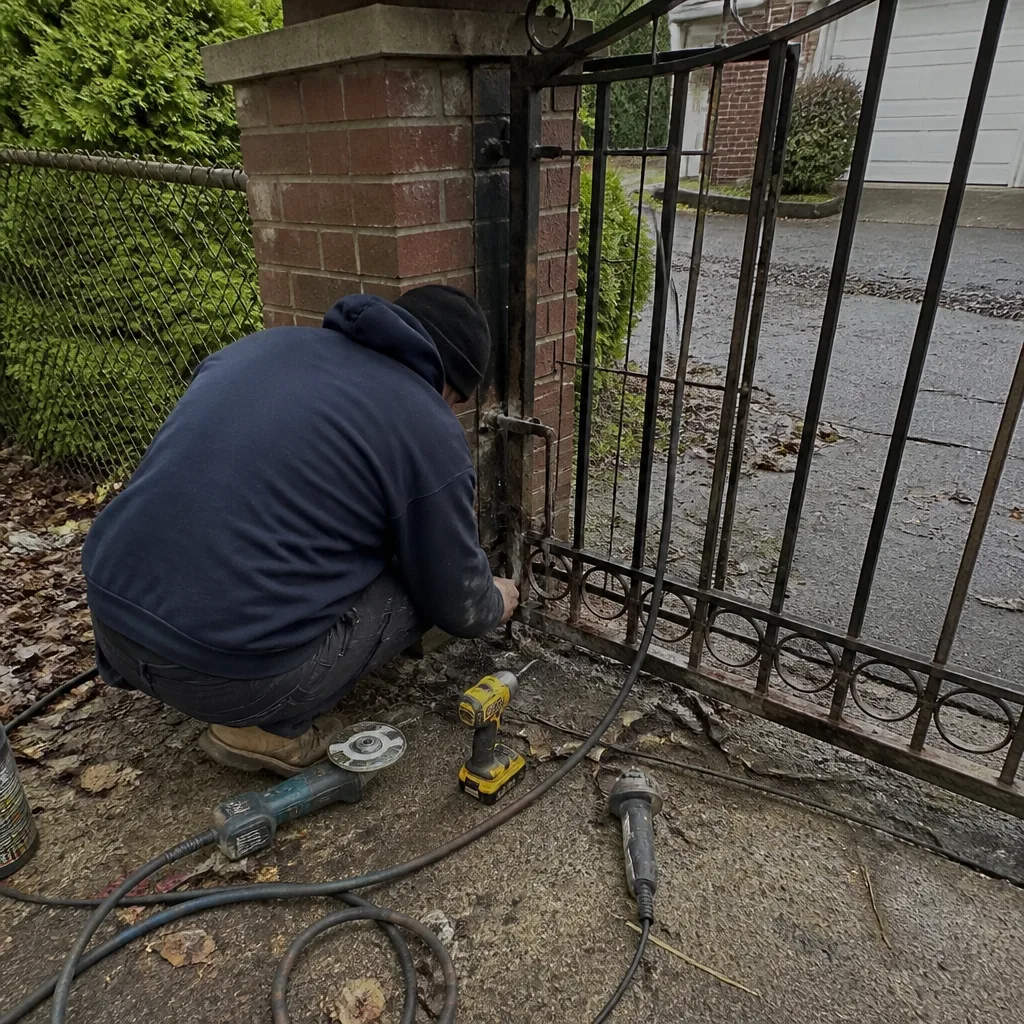 Before
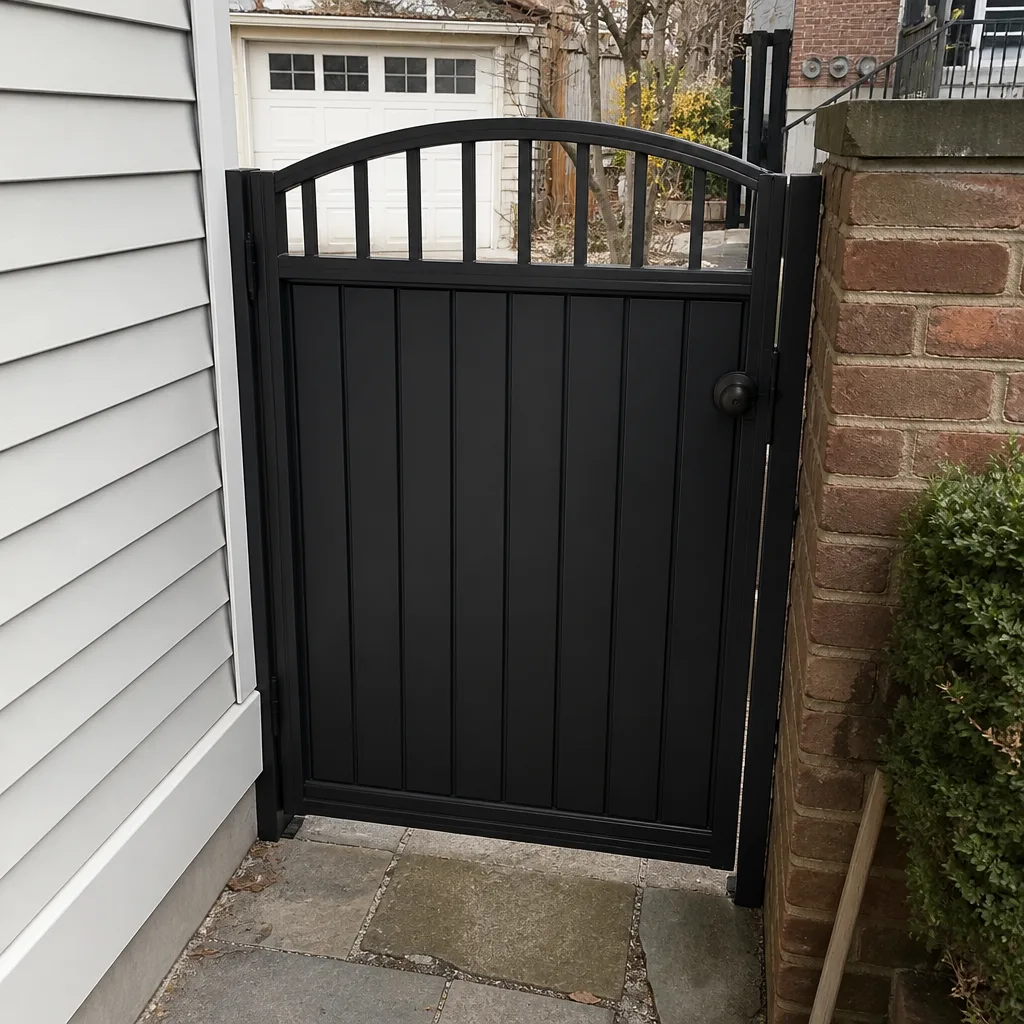 After
After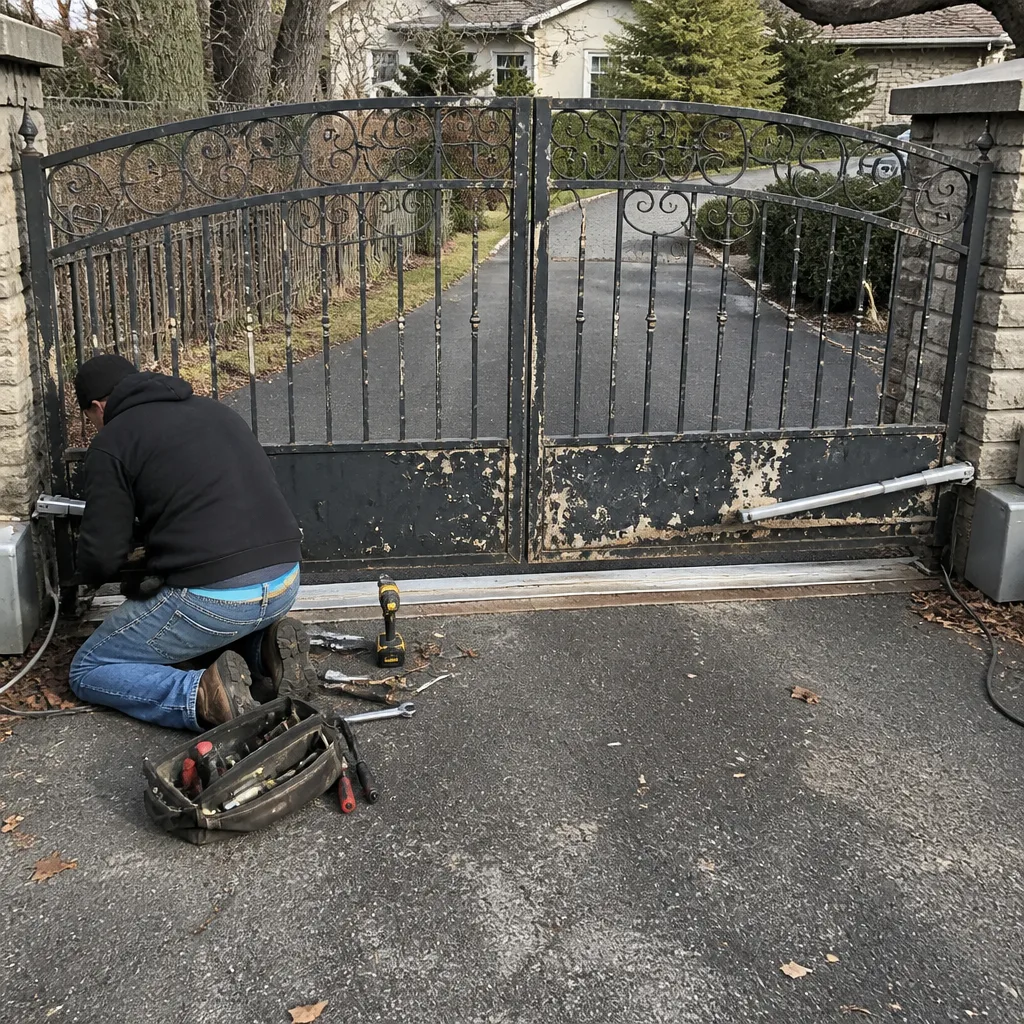 Before
 After
After Before
 After
After