
Last updated October 16, 2026
 Wrought iron
 Wood & steel frame
 Farm & ranch
 Sliding driveway gates
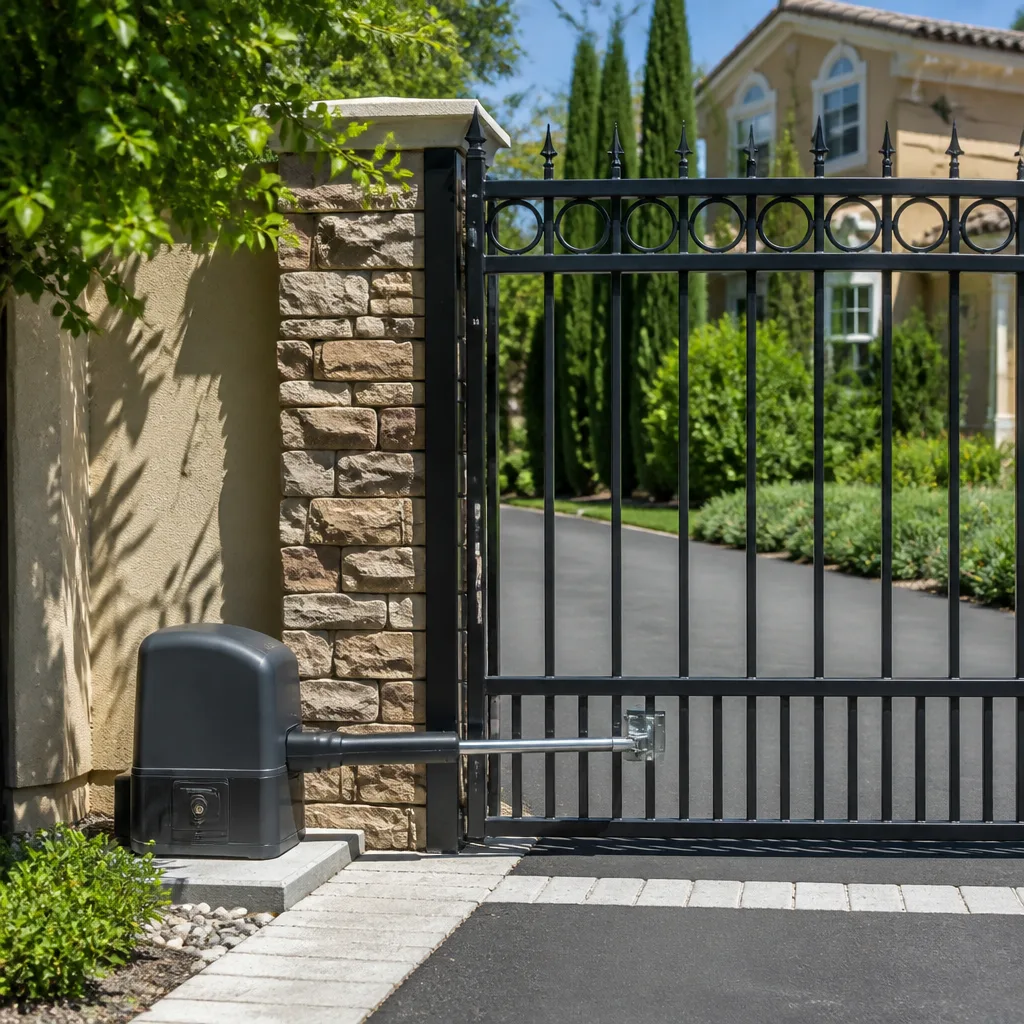 LiftMaster operators
Free on-site gate assessment - hinges, posts, and your LiftMaster or Nice gate operator checked before anything is quoted
The assessment is free and the quote is the invoice.
Get your free estimateDIY vs Professional Gate Repair: The New York Homeowner’s Decision Guide
Most DIY gate repair tutorials open with a cheerful “you can do this!” and close with an affiliate link for a multimeter. What they skip is the part that matters in New York: adjusting a limit switch or capacitor on an automated gate voids most manufacturer warranties, and if that gate later injures a delivery person or a neighbor’s child, the homeowner who last touched the wiring is the one standing in court. This guide walks through exactly which gate repairs a New York homeowner can safely handle, which ones carry real liability exposure, and what a failed DIY attempt actually costs when you have to call someone to undo it.
Styles & brands we work with
Quick Answer
For surface-level maintenance like lubricating hinges, treating rust on manual gates, or tightening a loose latch plate, a careful New York homeowner can absolutely DIY. For anything involving the motor, capacitor, circuit board, safety sensors, or structural welds on an automated gate, hire a professional for our Gate Repair services: the liability exposure in New York, the warranty implications, and the cost of undoing a botched fix outweigh any savings.
Table of Contents
- The Category System: DIY-Safe vs. Leave-It-Alone
- New York Liability: What Happens When a DIY Gate Repair Fails
- The Warranty Problem Most Tutorials Ignore
- The Hidden Cost of a Failed DIY Repair
- Tools You Actually Need for Legitimate DIY Gate Work
- How to Describe a DIY Attempt Honestly to a Contractor
- Common Mistakes to Avoid
- When to Call a Professional
- Frequently Asked Questions
- The Bottom Line
The Category System: DIY-Safe vs. Leave-It-Alone
Gate repairs fall into three buckets, and recognizing which bucket you’re in is the entire decision. The first bucket is genuinely safe for a homeowner with basic tools and a free afternoon. The second is risky, not because you’re not capable, but because the consequences of a mistake are severe. The third is firmly in “call someone” territory, and no tutorial can change that.
In our experience across gate repair in New York, the neighborhoods we serve see the same patterns: a swing gate dragging on its hinges in Queens, a slide gate jumping its track in Staten Island, a keypad that stopped responding overnight in the Bronx. The failures are predictable. What separates a $20 fix from a $1,500 lesson is mostly whether the job involves energized components or structural load.
Bucket One: Safe and Cost-Effective to DIY
- Lubricating hinges and rollers. A can of white lithium grease or a silicone spray, a rag, and ten minutes. Do this twice a year and you’ll avoid the most common cause of gate motor strain. Wipe off old grease first so you’re not trapping grit.
- Minor surface rust treatment. For a manual gate with cosmetic rust, wire brushing, a rust converter, and a coat of outdoor metal paint is honest work. This is prevention, not repair, and it’s safe if you’re not grinding welds or weakening structural members.
- Tightening a loose latch plate. If a manual gate latch wiggles but still catches, snugging the mounting screws and replacing a worn strike plate is a legitimate Saturday project. Use the same size screws; going longer can deform the post.
- Clearing debris from a slide gate track. Leaves, ice, gravel, a stray Amazon package: clearing the rail is maintenance, not repair, and it’s the single most common “fix” that doesn’t require a technician. In New York winters, frozen track debris accounts for a huge share of “my gate won’t move” calls.
- Replacing a manual gate’s pull handle or latch spring. If you can see the whole mechanism, remove two bolts, and swap in a matching part from a hardware store, that’s reasonable.
Bucket Two: Risky Enough That We Advise Calling
- Adjusting limit switches. The limit switch tells the motor where to stop. Getting it wrong means a gate that doesn’t fully close, or one that over-travels and burns out the motor, or one that crushes a car bumper. On a gate from a brand like Viking or Linear, the limit setting procedure is specific to the board revision, and one wrong dip switch change can scramble other settings.
- Replacing a capacitor. The capacitor stores enough charge to deliver a serious shock even with the power off. Discharging it incorrectly can damage the new part or the board. Our technicians treat every capacitor swap as energized work until proven otherwise.
- Rewiring any low-voltage control. Photoelectric sensor wiring, keypad wiring, intercom wiring: getting a wire crossed can fry the control board. A new board for a BFT or Ghost Controls operator runs in the hundreds, and the manufacturer won’t cover a board that failed due to miswiring.
- Welding or “fixing” a cracked gate frame. A cracked weld is rarely just a weld. The crack usually means the gate is out of square, hinges are worn, or a wheel is flat, and welding over the symptom leaves the cause in place. Plus, welding on a gate that isn’t properly supported can warp the frame.
Bucket Three: Never a DIY Job
- Any work on hydraulic gate operators. Hydraulic systems run under high pressure. A loose fitting can spray fluid, and a failed pressure relief valve turns the gate into an unstoppable force. This is not a homeowner repair.
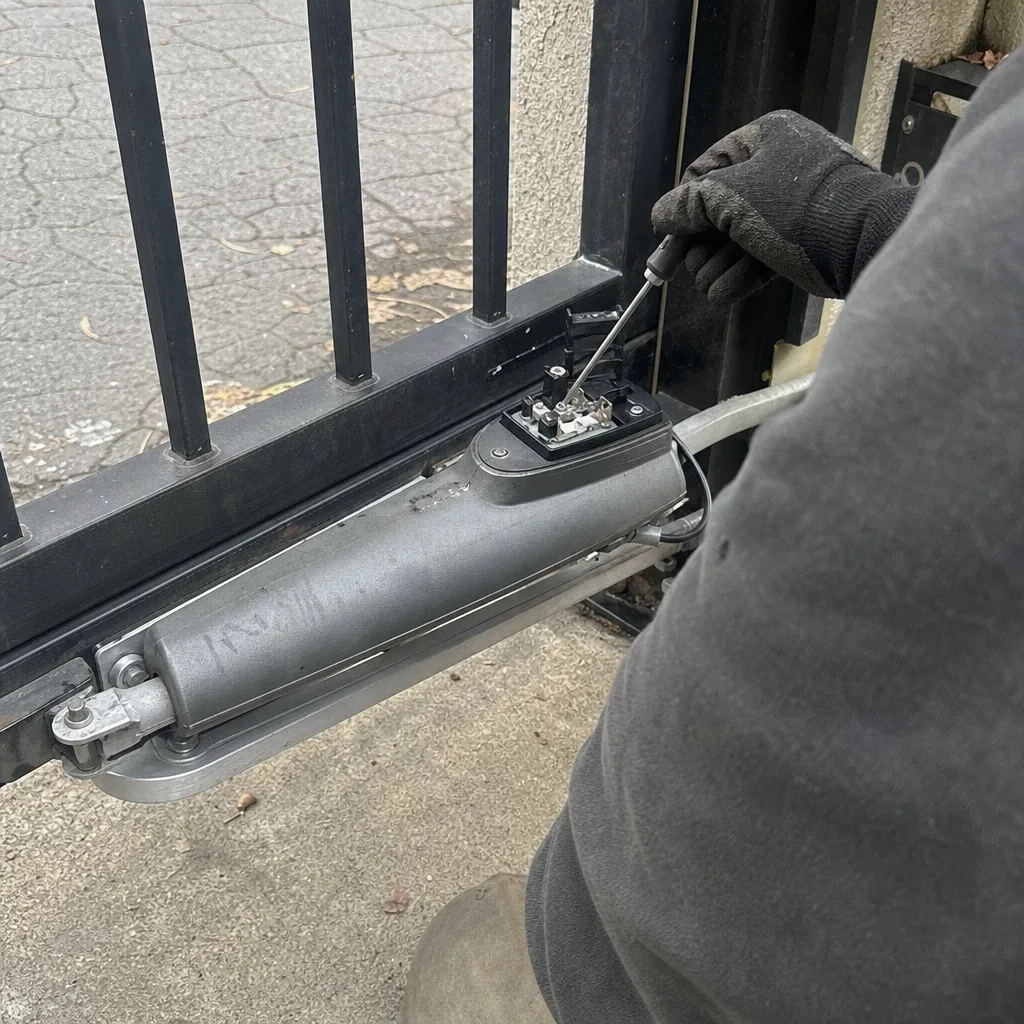
- Replacing a motor arm or actuator. The actuator, the motorized arm that physically pushes the gate open, carries the full weight of the leaf. Removing it without properly bracing the gate is how people get pinned. This is also where most of the structural load lives; a wrong-length actuator on a sloped New York driveway means a gate that binds and blows fuses.
- Safety sensor calibration on an automated gate. In New York, an automated gate without functioning safety edges and photo eyes is a liability event waiting to happen. Calibrating photo eyes so they detect a child-sized object at the correct height, across the correct gap, with the correct beam alignment, is specialized work.
- Any repair on a commercial or multi-tenant gate. If the gate is shared by a co-op, condo association, or any property with multiple residents, the repair is not yours to make. The building’s insurance and the gate’s compliance status matter in ways that override any DIY savings.
For Bucket Two and Three work, call a professional. At Portcullis, we give electric gate repair in New York customers a written price before any work starts, so you’re never surprised after the gate is already in pieces.
New York Liability: What Happens When a DIY Gate Repair Fails
Here’s the part almost no DIY tutorial mentions. In New York, property owners owe a duty of reasonable care to anyone lawfully on the property. A delivery worker walking up your driveway, a neighbor’s kid retrieving a ball, a postal carrier at the gate intercom: if an automated gate you repaired injures any of them, the question in a lawsuit is not whether you meant to do harm. It’s whether you acted reasonably. A plaintiff’s attorney will ask who last worked on the gate. If the answer is “the homeowner, following a YouTube video,” you’ve lost that argument before discovery begins.
New York also has specific code and insurance considerations. Many co-ops and condo boards in New York require gate work to be performed by a licensed, insured contractor, and the building’s policy may exclude coverage for damage caused by unpermitted or unlicensed modifications. That means if your DIY gate repair fails and damages a car, a neighboring fence, or a person, you may be paying out of pocket. Your homeowner’s insurance policy may also decline to defend you if the work falls outside the scope of “ordinary maintenance.”
We’re not saying this to scare you away from tightening a latch. We’re saying it because the phrase “it’s just a gate” collapses under the weight of the reality in New York: dense property lines, shared driveways, multi-unit buildings, and a litigious environment. A self-repaired automated gate that closes on someone is the kind of case personal injury firms take on contingency.
One more New York-specific angle: the climate. Salt, freeze-thaw cycles, and heavy snow put stress on gates in ways a warm-weather tutorial never accounts for. A DIY fix that works in a Florida garage video may fail in a January cold snap in the Hudson Valley. Seized rollers, frozen photo eyes, and brittle wiring insulation are all amplified by New York winters. A professional repair takes those conditions into account and uses components rated for the environment.
The Warranty Problem Most Tutorials Ignore
Every major gate operator manufacturer, including BFT, Linear, Viking, and Ghost Controls, writes its warranty around the assumption that a qualified technician installed and services the equipment. The fine print is consistent: unauthorized modification, disassembly, or repair voids coverage. That means the $40 you save doing a capacitor swap on a Viking operator yourself can turn into a full-price board replacement, part and labor, when the system fails later. We’ve seen this in the field: a homeowner changes a limit switch, the gate over-travels, the gearbox strips, and the manufacturer denies the claim because the unit’s settings were altered by an unapproved party. The repair that would have been covered becomes the homeowner’s bill.
This matters more in New York than in a rural setting because gates here are often more expensive, more integrated, and more depended-upon. A New York driveway gate may be tied to a home security system, a video intercom, and a remote access app. One botched adjustment can cascade through the whole system.
When we service a gate under a manufacturer’s warranty, we document the work and verify the configuration. That documentation is part of what protects the homeowner’s coverage. A DIY repair has no documentation, no receipt, no service record. If something fails later, you’re negotiating with a manufacturer from a position of no evidence.
The Hidden Cost of a Failed DIY Repair
The most expensive gate repair we perform isn’t the catastrophic failure. It’s the quietly botched DIY attempt that left the system “almost working.” Here’s what that costs, in the order the bills arrive.
First, there’s the parts you bought. The wrong capacitor, the miswired keypad, the oversized latch spring: these are sunk costs, and they rarely survive contact with the actual problem. Second, there’s the time. A homeowner might spend six or eight hours across two weekends chasing a gate issue. Time has value, and so does the frustration of a gate that works intermittently.
Third, and this is the one nobody budgets for: the diagnostic premium. When a technician arrives to find a gate that was partially disassembled, with unfamiliar parts installed and settings changed, the first job is figuring out what the homeowner did before figuring out what was actually wrong. That’s real labor, and it’s billed. A gate that might have been a straight $250 limit switch adjustment can become a $600-plus repair because the technician has to reverse-engineer the failed DIY attempt first. We don’t charge a “DIY penalty,” but we do charge for the time it takes to safely undo and redo work, and that time is longer when the last hands on the gate were untrained.
Fourth, there’s the safety risk you’ve been living with. A gate that “mostly works” after a DIY fix may not be closing fully, may not be reversing on obstruction, may not be latching securely. Every day it operates in that condition is a day of exposure, in the New York liability sense we covered earlier.
The honest math: for everything except the Bucket One maintenance tasks we listed, the expected cost of a professional repair is lower than the expected cost of a failed DIY attempt when you include parts, time, the correction premium, and the risk.
Tools You Actually Need for Legitimate DIY Gate Work
Here’s a tool list for the genuinely safe assignments, with one caveat: if any of the “never attempt” tools shows up in a tutorial you’re watching, close the tab. The presence of the wrong tool is the clearest signal that a tutorial is dangerously out of its depth.
- A multimeter, for the jobs where you’re only testing, not repairing. If you want to confirm a keypad is getting power before calling us, that’s fine. Testing is safe. Replacing the board the multimeter points to is not.
- White lithium grease and a clean rag. For hinge and roller lubrication. Avoid WD-40 as a long-term lubricant: it’s a solvent and a water displacer, and it washes out the good grease.
- Wire brush, rust converter, and a can of oil-based outdoor metal paint. For surface rust treatment on manual gates. Not for wire-wheel grinding anywhere near a motor or sensor.
- A set of properly sized wrenches and a torque habit. Over-tightening a hinge bolt can crush a bushing. Under-tightening it can let the gate sag. Snug, not hulk-tight.
- A flashlight and a phone camera. Before you touch anything, take clear photos of the wiring, the settings, and the connections. If you do decide to call us later, those photos shortcut the diagnostic.
- Work gloves and eye protection. Even the safe tasks involve metal edges and rust flakes.
The tools that signal “stop and call someone”: an angle grinder, a welder, a hydraulic fitting wrench, a high-voltage probe, or any tutorial that tells you to “discharge the capacitor with a screwdriver.” A capacitor can hold a lethal charge, and the screwdriver method can damage the board. That’s a $15 screwdriver turning into a $400 board replacement, plus a shock risk.
If you’ve found yourself already in possession of one of those “stop” tools in the context of a gate project, our New York gate repair team is the call to make. The consult is free, and the price is written before work starts.
How to Describe a DIY Attempt Honestly to a Contractor
We understand the impulse to downplay the DIY attempt. Nobody wants to admit they made something worse. But here’s the thing: a contractor who arrives to find a gate with signs of prior work already knows, or will know within ten minutes. Being upfront doesn’t change the truth; it changes the price.
When you describe a repair attempt honestly, you save the technician time. The tech doesn’t have to discover that the actuator was removed by testing for a stripped bolt. You tell them what you touched, what you replaced, what stopped working, and when. That compresses the diagnostic from an hour of forensic work to fifteen minutes of verification. You’re billed for the time actually spent, and you get an accurate diagnosis faster.
Here’s how to describe an attempt, in order:
- What the original problem was. “The gate would close halfway, then reverse.”
- What you tried, in sequence. “I adjusted the limit switch, then I replaced the capacitor, then I put everything back.”
- What changed after each attempt. “After the limit switch change, it closed all the way but buzzed. After the capacitor swap, nothing.”
- Any parts you bought and where. This matters: a counterfeit capacitor from an online marketplace is a recognized failure pattern. Knowing you bought a $12 no-name part tells the tech to test it before trusting it.
- Whether the gate has been running at all since. “It’s been dead for a week” versus “it runs but reverses randomly.”
This information lets us give you a more accurate quote on the first call. When Dean Prescott or one of our techs walks up, the service record starts with your honest account, and the written price reflects real work, not guesswork.
What doesn’t help is hoping we won’t notice. We notice. Every manufacturer uses different board layouts, and a trained tech recognizes non-factory wiring in seconds. The best price comes from the truth, and we honor it with the same straight-forward approach: gate installation in New York and repair, priced upfront, guaranteed in writing.
Common Mistakes to Avoid
- Lubricating with WD-40 and thinking the job’s done. WD-40 displaces moisture and cleans, but it’s not a lubricant. Two weeks later the hinges are dry and squeaking again. Use white lithium grease, and wipe off the old grease first so you’re not making a paste.
- Adjusting limit switches “just a little” to fix a different problem. A gate that doesn’t close fully usually has an obstruction, a bad safety sensor, or a worn gear, not a limit switch problem. Moving the limit switch masks the real fault and creates a new one.
- Using a longer or thicker bolt than the original. A hinge bolt that’s longer than the original can put pressure on the opposite side of the post, or contact the gate frame and bind it. Match the size exactly.
- Testing a repair by standing in the gate’s path. We shouldn’t have to say this, but we see it. Never test an automated gate by letting it close toward you. Use a cardboard box or a trash can, and stand to the side.
- Buying “universal” replacement parts from an online seller. A universal receiver may not talk to your existing keypad. A universal actuator may not fit your BFT or Linear opener without a mounting plate. Universal usually means “fits nothing perfectly.”
- Forgetting New York winter in the planning. A gate that works in October can freeze to the ground in January if the hinges aren’t adjusted and the track isn’t clear. Lubricate before the cold sets in, not after the gate stops moving.
- Ignoring the manufacturer’s service manual in favor of a video. The manual for your specific operator model contains torque specs, limit-setting procedures, and safety warnings the video skipped. Videos are general. Your gate is specific.
When to Call a Professional
Call a professional when the gate is automated and the problem is not in the list of safe maintenance tasks. Call when the gate makes noise it never made before, when it reverses for no reason, when it’s slow in one direction, when the keypad stops responding, when the remote range drops, when the gate sags, when the track looks bent, or when you smell something electrical. Call when the gate is shared by a co-op or condo association. Call when the warranty is still active. In New York, with the liability and weather factors we’ve covered, “call someone” is the financially rational choice for everything except surface maintenance. For Gate Repair Cost Breakdown: The New York Homeowner’s Reference for 2026, see our detailed guide, or call Portcullis Gate Repair New York for a free estimate-every estimate includes a written price before any work begins.
Frequently Asked Questions
Gate repair in New York typically runs from $150 to $900 depending on the component. A limit switch adjustment or photo eye realignment usually falls in the $150 to $300 range, a receiver or keypad replacement is generally $250 to $500, and a swing-gate actuator swap runs approximately $600 to $1,200 parts and labor. Slide gate motor replacements are usually $800 to $1,800. Call (845) 259-0242 for an exact quote, estimates are free, and the price is written before work starts.
You can safely perform surface maintenance like lubricating hinges, clearing track debris, and treating minor rust on a manual gate. For anything involving the motor, capacitor, control board, sensors, or structural welds, hiring a professional is the safer choice in New York due to manufacturer warranty limits and property owner liability rules; see our Gate Repair Maintenance Checklist for New York Homeowners for the tasks you can safely handle yourself.
In most cases, yes. Manufacturers including BFT, Linear, Viking, and Ghost Controls state that unauthorized modification, disassembly, or service voids the equipment warranty. If a component fails after a homeowner has altered the settings or wiring, the claim will likely be denied.
If a gate you repaired injures a delivery worker, neighbor, or visitor, New York property owner liability law may hold you responsible. The inquiry will focus on whether you acted reasonably, and a self-performed repair with no service record is hard to defend. Some co-ops and insurance policies also exclude coverage for damage from unlicensed gate modifications.
We don’t charge a penalty, but the diagnostic time is longer when a technician has to reverse-engineer a homeowner’s prior work. That time is part of the written estimate. Being upfront about what you tried gets you a faster diagnosis and a more accurate quote. Call (845) 259-0242 and tell us exactly what happened, we’ll give you a straight answer.
Yes. We service residential and commercial gates, including multi-unit buildings, across New York. Co-op and condo board requirements often mandate that gate work be performed by a licensed, insured contractor, and we provide the documentation boards need. Estimates are free, and every job includes a written Kingswell Guarantee.
The Bottom Line
The DIY versus professional gate repair decision in New York is not a test of your skill. For more guides & resources, visit our blog. It’s a risk calculation with a clear boundary line. Surface maintenance on a manual gate? Go ahead, use white lithium grease and a torque wrench. Anything with a motor, a capacitor, a sensor, or a weld? The math, in warranty terms, liability terms, and correction-premium terms, points to a licensed professional. Portcullis Gate Repair New York has served New York since 2008, and every job is backed by the Kingswell Guarantee: a written price before work starts, a written guarantee on the repair, and the 365-Day Done Right Promise. If you’re in the second or third bucket, call (845) 259-0242. We’ll tell you what it costs before we touch anything.
Written by Dean Prescott, Owner at Portcullis Gate Repair New York, serving New York since 2008.
See the difference
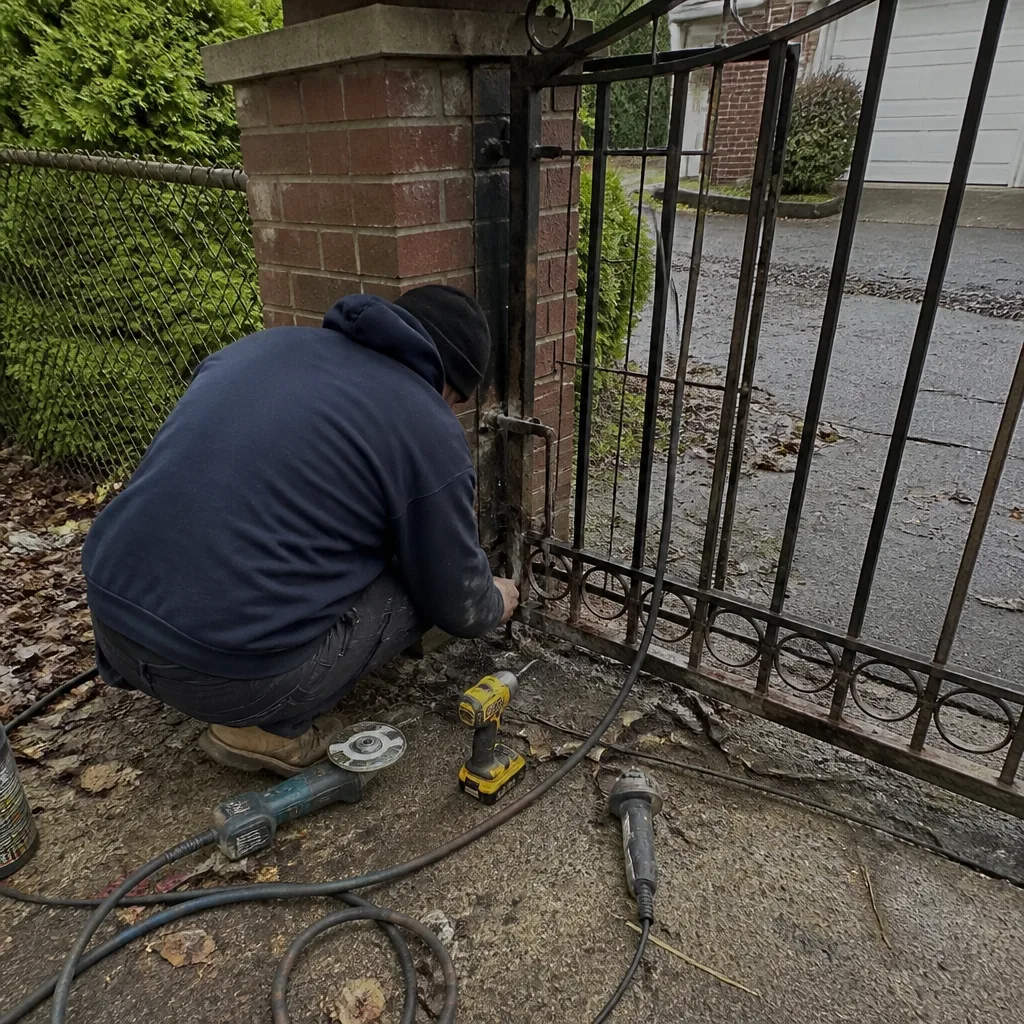 Before
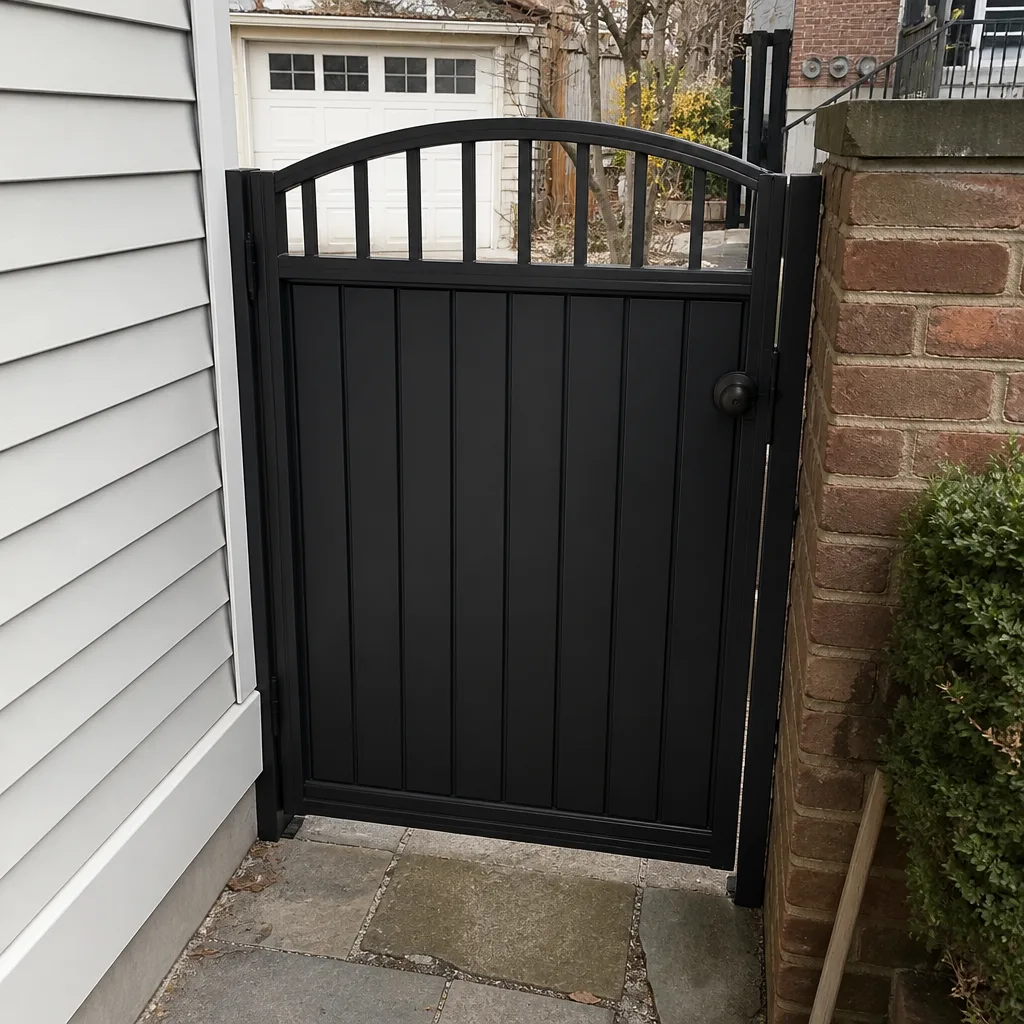 After
After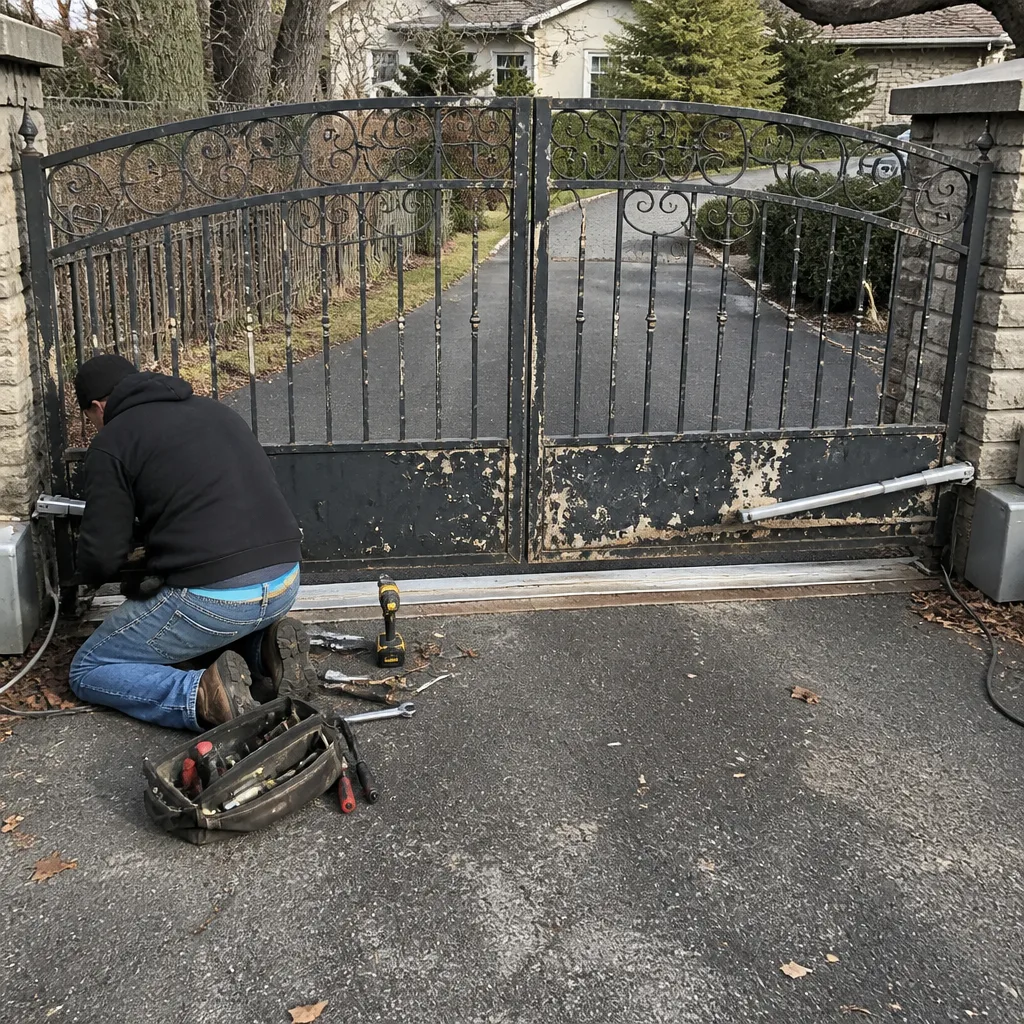 Before
 After
After Before
 After
After